
Student Aid Explained: Grants, Work Study, Loans, and What to Do First
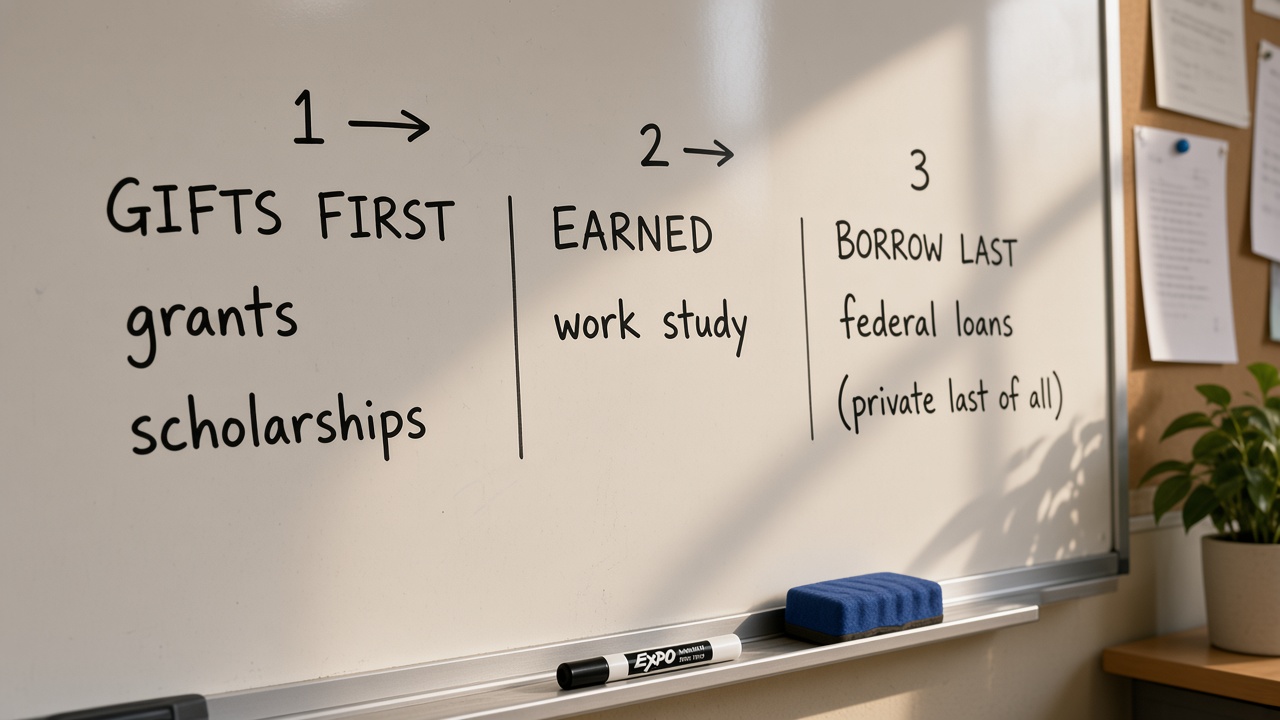
Student aid is money from the federal government, a state, a school, or another organization that helps pay for college, career school, or trade school. It includes grants and scholarships you usually don’t repay, work study you earn on the job, and loans you repay with interest. Treat it as a toolkit. Use the free and earned pieces first. Borrow last.
Most families hear “student aid” and jump to one of two stories:
It’s free money.
We won’t qualify, so why bother.
Both are wrong. Student aid is a strategic funding stack. Your job is active ownership: map the stack, compare net cost, and refuse to let max loans become the plan.
What is student aid?
Federal Student Aid (U.S. Department of Education) defines student aid as money from the federal government or another entity (school, state, other) to help pay for college, career school, or trade school. Official types overview: StudentAid.gov.
In practice, student aid funds:
Tuition and fees
Often other education costs in a school’s cost of attendance
A mix of gift aid, earned aid, and borrowed aid
It is not one check. Schools assemble it into an aid offer. You decide what to accept.
What’s the difference between student aid and financial aid?
Financial aid is the umbrella families and counselors use every day. Student aid is the phrase federal materials use for money that helps students pay for postsecondary education.
Don’t invent a jargon fight. Run this:
Say “financial aid” in conversation.
Read “student aid” on federal sites without getting stuck.
Ask the only question that matters: What help is gift, what is earned, what must we repay, and what’s the real cost after aid?
What types of student aid are there?
Four buckets. Master these before you argue about schools.
Grants (usually no repayment)
Need-based gift aid. Federal grants (including Pell for eligible undergrads), state grants, and school grants show up here. Limited exceptions can require repayment (for example, early withdrawal).
Move: Count grants as real cost reduction. Don’t use them as permission to stretch into a worse fit.
Scholarships (usually no repayment)
Gift aid by criteria: academics, talent, major, background, and more. Sources include colleges, employers, community groups, and private organizations.
Move: Map scholarships early. April panic is a losing strategy.
Work study (earned)
Federal Work Study funds part-time jobs for eligible students with need. You earn it. It is not a grant sitting in an account before you work.
Move: Use it for books and living costs. Confirm how each school packages and pays it.
Loans (must repay)
Loans are aid. They are not free money. Federal student loans (and some parent loans) can appear in offers. Private loans sit outside the federal system and usually bring fewer protections.
Move: Accept only what you need after gift aid and a clean net-cost comparison. Max loan ≠ recommended loan.
Bucket | Repay? | Builder read |
|---|---|---|
Grants | Usually no | Need-based gift |
Scholarships | Usually no | Criteria-based gift |
Work study | N/A (you earn it) | Job tied to need |
Loans | Yes + interest | Debt tool, not a prize |
How do I apply for student aid?
The main door for federal aid (and often state/school aid) is the FAFSA® form.
Execution rules:
File every year you’re in school. One form does not cover four years.
File early. Federal deadlines stretch out. State and school deadlines hit sooner, and some funds run out.
Don’t skip FAFSA because “we make too much.” Income matters. It is not the only factor. Filing keeps federal, state, and institutional doors open.
Use official sources for steps and dates. Start at StudentAid.gov and the FAFSA deadlines page. For 2026–27, the federal submit deadline is June 30, 2027 (11:59 p.m. Central). Your state’s priority date may be much earlier. Re-check before you file or publish.
This is not a full FAFSA tutorial. Separate post. Here the move is simple: get in line early. Kill the myths that keep you offline.
What does the aid offer actually mean?
An aid offer (award letter) is a package for one school: grants, scholarships, work study, and loans.
Read it like an investor:
Package ≠ sticker price. Cost of attendance is not your bill.
Compare net cost. Cost minus gift aid (grants + scholarships). That number decides School A vs School B.
Split gift from loans. A “big” offer stuffed with loans is still debt. Gift first. Loans last.
A high sticker school with strong gift aid can beat a “cheaper” school financed with max loans. Run the math. Don’t outsource the decision to prestige.
Where families get stuck
Fix these before they cost you:
Waiting too late — Miss state/school priority dates and options shrink quietly.
Skipping FAFSA — “We won’t qualify” is a guess. Filing is the test.
Treating max loans as the plan — If the budget only works at the loan ceiling, the school or the path is wrong.
Picking the school before the money plan — Emotion first, debt math later is how families overborrow.
Order of operations (active builder):
Clarify direction (program + outcome)
Map free money (scholarships + likely gift aid)
Understand need-based aid and what FAFSA unlocks
Borrow last, and only after net-cost comparisons
Not every student needs the most expensive school. Student aid works inside an affordability and direction plan. It fails as a rescue after the decision is already emotional.
Education Encompassed: aid inside a funding strategy
At Education Encompassed, student aid is not a last-minute scramble. It sits inside affordability and fit:
Scholarship mapping so free money is pursued on purpose
Affordability analysis so net cost drives comparisons
Debt minimization before applications and deposits lock you in
Career alignment and strategic admission positioning matter. Lightly here. Right program at a workable cost beats a prestige name financed with years of regret.
Next move: Run the free program recommendation quiz, or talk with an Expert about an affordability plan, before loan season becomes the only season left.
