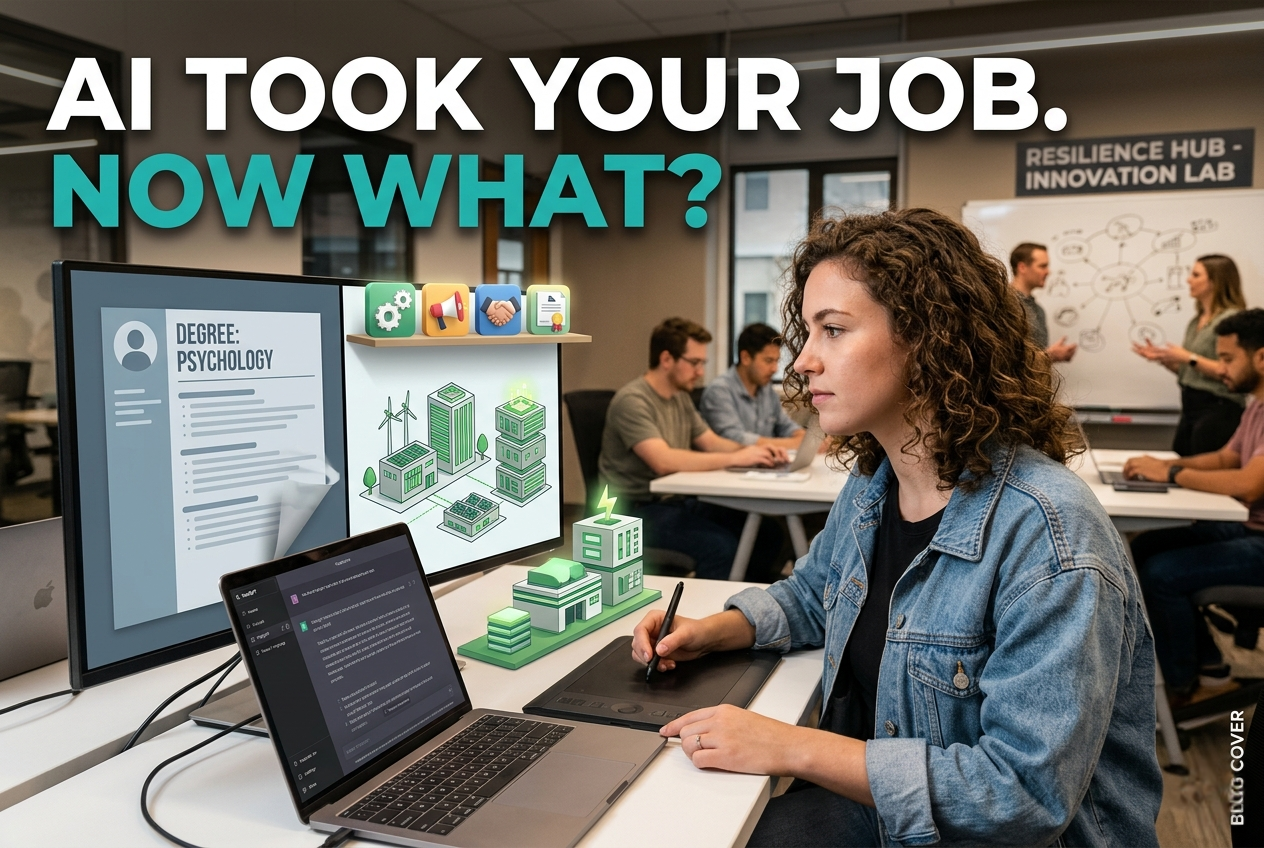
AI Took Your Job. Now What?
AI Took Your Job. Now What?
Skynet is here.
Okay, maybe not Skynet. Maybe it is ChatGPT. Maybe it is something else entirely. But whatever it is, it is AI, and it is sitting in your future career like it owns the place.
So what are you going to do about it?
First, Stop Panicking. Then Start Planning.
AI is not here to steal your job. Well. Kind of.
Here is the honest answer. It is helping some careers. It is hurting others. And yes, it is outright replacing a few. But here is the thing nobody is saying loudly enough.
AI is a tool. That is it. A tool. And like every tool ever invented, the people who learn how to use it well are the ones who win. The ones who ignore it are the ones who get left behind.
Colleges know this. Right now, they are building programs and curricula designed to prepare students for a world where AI is part of the job. Not the enemy of it. Part of it.
So the question is not whether AI will impact your career. It will. The question is whether you are going to be the person who knows how to use it or the person who got replaced by someone who does.
A Degree Alone Will Not Get You a Job. Full Stop.
Here is a truth that is going to sting a little.
Everyone has a degree.
Everyone is an engineer. Everyone is a psychologist. Everyone is a doctor, a business major, a communications grad. The job market is flooded. And if all you have is a diploma, you are one face in a very large crowd.
So how do you stand out?
Skills. Stackable skills.
Not textbook knowledge. Not test scores. Real, demonstrable, marketable skills that you can put in front of an employer and say: this is what I bring that nobody else does.
What does that look like?
Communication. Can you clearly explain a complex idea to someone outside your field? That is rarer than you think.
Leadership. Did you run a project? Did you manage people? Did you keep a team from falling apart when that one person, you know who, did absolutely nothing?
Time management. Every employer wants this. Most people just say they have it. Show it.
Team management. Working with people is a skill. Working with difficult people is a bigger one.
Specialization within your major. You studied general psychology but crushed it in economic game theory? Congratulations. You are now a game theorist. Put it on the resume.
Every class, every project, every group assignment where you had to deal with the person who took over everything and ran it like a dictatorship? That is experience. That is a skill. That is something you learned about leadership, management, and people.
Use it.
Stack Your Skills Like This
Think of your college career as a construction project. Every experience is a brick.
Join clubs and student organizations. That is team building. That is leadership. That goes on a resume.
Play intramural sports. Team dynamics. Communication under pressure. Resume.
Volunteer. Community involvement. Values alignment. Resume.
Take the harder elective in your major, the one that scares you a little. If you do well, that is a specialty. Own it.
Learn AI tools relevant to your field. If you are a marketer, learn how to prompt. If you are an engineer, learn how to integrate. If you are in healthcare, learn the compliance landscape around it.
And if you look at your college experience right now and realize you have not stacked anything?
Build that. Start today. Google it. Use ChatGPT. Look it up on Wikipedia. There is no excuse for not knowing where to start in 2024. The information exists. Go get it.
The Real Secret to Getting a Job: Internships
Here is where it gets real.
A degree gets you in the door of the conversation. An internship gets you the job.
The majority of jobs come from internship pipelines. That is not an opinion. That is how hiring works. Companies hire people they have already worked with, or people who were referred by people they already trust.
So how do you get an internship?
You create one.
Research the companies you want to work for. Know their mission, their leadership, their current projects.
Find the person worth emailing. Not HR. The actual human doing the work you want to do.
Send the email. Introduce yourself. Share your background. Attach your resume. Then, and this is the critical part, ask what you can do for them. Not what they can do for you.
No response? Show up. Go to the office. Knock on the door. Offer to bring coffee. Seriously. If someone brought me coffee right now, I would find a way to put them to work.
Go to career fairs. Freshman year. Sophomore year. Junior year. Every single year. Senior year should ideally be when you already have the internship. But if not, career fairs.
I have a friend named Chigozi. He said something that has stuck with me ever since. You have to know how to know who to know.
Read that again.
You have to know how to know who to know.
He flew out to Washington DC on his last dollar to try to get a job. He did not get the job. But he made such an impression that the people in that office created a position for him. He went on to travel the world. Built a great life. Great family.
He created his own opportunity. You can do the same.
The Timeline Nobody Gives You
Most students wait until junior or senior year to start thinking about internships and careers. That is too late.
Here is the actual timeline:
Freshman year: Go to the career fair. Yes, already. You are not applying for jobs. You are learning who is in the room and building a face.
Sophomore year: Go back to the career fair. You have a face now. Build on it. Start identifying the organizations you want to target.
Junior year: Career fair, networking, and by now you should be actively pursuing internship opportunities.
Senior year: If everything went right, you have an internship and a foot in the door. If not, career fair, and also go talk to your professors.
Your professors are underused. They are doing research. They have industry connections. Ask to be involved. Ask to help. Get the experience however you can, and then figure out how to market it.
That is the hustle. And it starts the moment you step on campus, not when graduation is three semesters away.
The Bottom Line
AI is changing the game. The degree market is saturated. The job market is competitive. None of that is going away.
But here is what is also true.
The people who build real skills, who stack experiences, who create their own opportunities before anyone hands them one? Those are the people who come out the other side with a career they actually wanted.
That is the standard. Go set it.
